
Voltage divider as voltage source
The voltage divider shown in figure 1 is in an unloaded state, as the entire current supplied by the power supply flows through the resistors  and
and  connected in series. A resistor parallel to loads the voltage divider.
Set the voltage on the power supply to
connected in series. A resistor parallel to loads the voltage divider.
Set the voltage on the power supply to  and measure the exact voltage with a multimeter. Set up the measuring circuit shown in figure 1.
For the connected load
and measure the exact voltage with a multimeter. Set up the measuring circuit shown in figure 1.
For the connected load  =
=  , the voltage divider represents a voltage source. Like any voltage source, it has a source voltage (also called the original voltage)
  and an internal resistance
  . The internal resistance of a voltage divider considered as a voltage source results from the parallel connection of the divider resistors and :
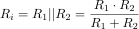
Use the measured values of resistors and to calculate the internal resistance of the voltage source:


The power  supplied by the power supply can be calculated using the following equation:

The power consumed by the load resistance can be determined using the following formula:


Draw the equivalent voltage source of the voltage divider:
What would be the value of  without ?

Calculate  and
and  for = using the values of the equivalent voltage source: (Provide formulas!)


Check the values by measuring:


Check the values using Kirchhoff's rules:
(Provide formulas!)